
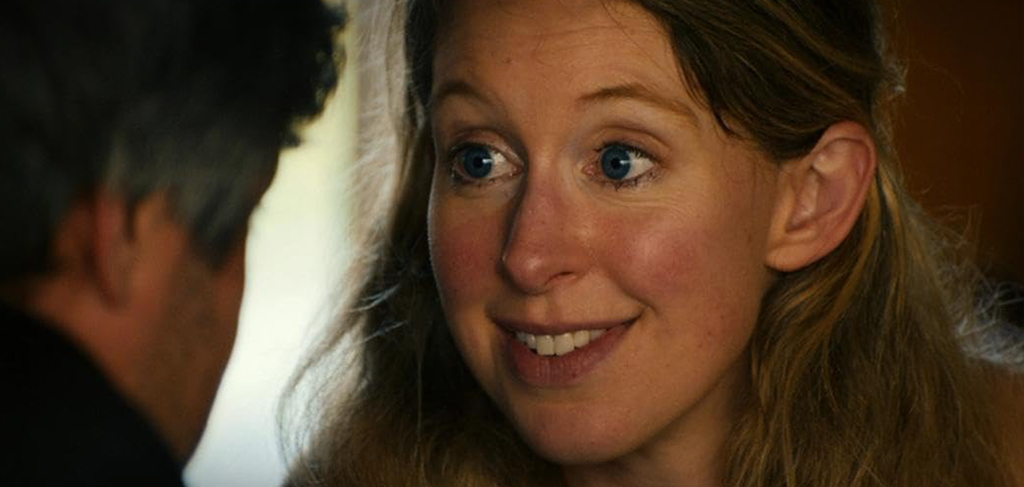
YOU CAN SEE EVERYTHING (2026)
Can you ever really know a person? Probably not entirely, but is it safe to assume that if you spend enough time up close and personal, people, in general, will show you who they are byway of their temperaments, the decisions they make and the way you feel when you’re with them? With time, we learn who does and doesn’t deserve our love, time and trust. And visa versa. So we are, like a lot of you out there who’ve seen this fascinating film, feeling more confused than ever about the disgraced and mysterious Theranos founder Elizabeth Holmes. Co-directors Nathan Fielder and Lance Oppenheim gave us three captivating hours trying to peel back Holmes’ layers during her final 34 days of freedom immediately before her 135 month prison sentence was to begin in 2023 (Holmes was found guilty of defrauding investors in her blood-testing startup). And so we have the deadpan master of cringe-reality – notably past projects being Nathan For You (2013-2017) and The Rehearsal (2022-2025) – confronting one of Silicon Valley’s most notorious con artists. Interesting choice, still let’s find out who she is and how she’s capable of such lies? Well, we’re presented with a maternal, soft-spoken, wide-eyed woman who’s ditched the put-on, low tone voice and black turtleneck in favour of radical transparency and extreme close-ups. She claims she has nothing to hide as tears stick to her unblinking eyes. Okay. Enter Billy Evans, heir to the luxury Evans Hotels chain and father to her two children. He at least fills the villain void with his intense, overbearing nature and constant attempts to control the filmmakers’ narrative. Evans has power of attorney over Holmes and runs her verified X (Twitter) account. Oh and he also manages an AI-generated likeness of her (sorry ladies, he’s taken). Still, we see firsthand that Holmes and Evans walk and talk like a loved-up couple and we spend a lot of time observing them, with Nathan onscreen interjecting every so often. And Fielder’s no dummy, we know he knows how and when to telegraph naiveness. But it’s never enough to see anything conclusive about the pair, especially without an obvious narrative or agenda. Something is off. That we know. Or do we? We won’t spoil exactly how, but Fielder cleverly and indirectly piles on the obvious suspicions and conclusions us viewers have with the help of a clever proxy, who pushes the desire for authenticity within the growing ensemble. And you see it. And that’s the rub. During her 2021 trial, Holmes claimed that her former partner and Theranos COO, Sunny Balwani, emotionally and psychologically controlled her, dictating everything from her diet to her business decisions. Is Holmes a victim again? Or has Holmes staged the same narrative? It becomes unclear whether Evans is truly controlling her, or if Holmes is once again allowing a male partner to take the fall as the “villain” to soften her reputation. Is it all coping? Which makes our next point more fathomable; what if Fielder isn’t exposing Holmes outright? Is he playing along in order to reveal to us who she is by way of exposing the masks she wears? Did Fielder give Holmes all the rope she needed to reveal her duplicity in front of an audience? In doing so, did he expose the mechanics of her manipulation far more effectively than a traditional interrogation ever could? Are we watching a seasoned performer attempt to direct her own documentary in real time? Or is she literal with no ill-intent, living moment to moment with little regard for the past or future? Are we watching a misunderstood infantilized woman being controlled by men? Fielder comes across as perplexed, but was and is this the ongoing antics of a magician? Another one of Fielder’s characters? Is he daring us to ignore our own eyes? Is he really no closer to forming an opinion and the end game is to let us decide after watching hours of sincerity mixed with deceit? You Can See Everything is riveting, darkly funny and deeply disorienting because either (to the cynics) none of the players ever breaks character; or (to the optimists) they show us their true blue selves and we’re just not used to openness without ethics. And is this even a documentary or an installation piece about the impossibility of documentaries? Can Fielder remain unbiased as he observes his subjects? We continue to argue over what really went down here. We can look, but we can’t ever really know a person, Fielder included. He’s curious and exudes neutrality, leaving us to figure out that being storytellers is all that they ever were.
WATCH OR NOT: WATCH
Additional musings: One of the best this year.
Leave a Reply